Our Offerings
Rites and Responsibilities offers a wide range of community, land-based, and online offerings, all oriented toward the long, slow work of cultural repair, healing, and regeneration. These offerings include:
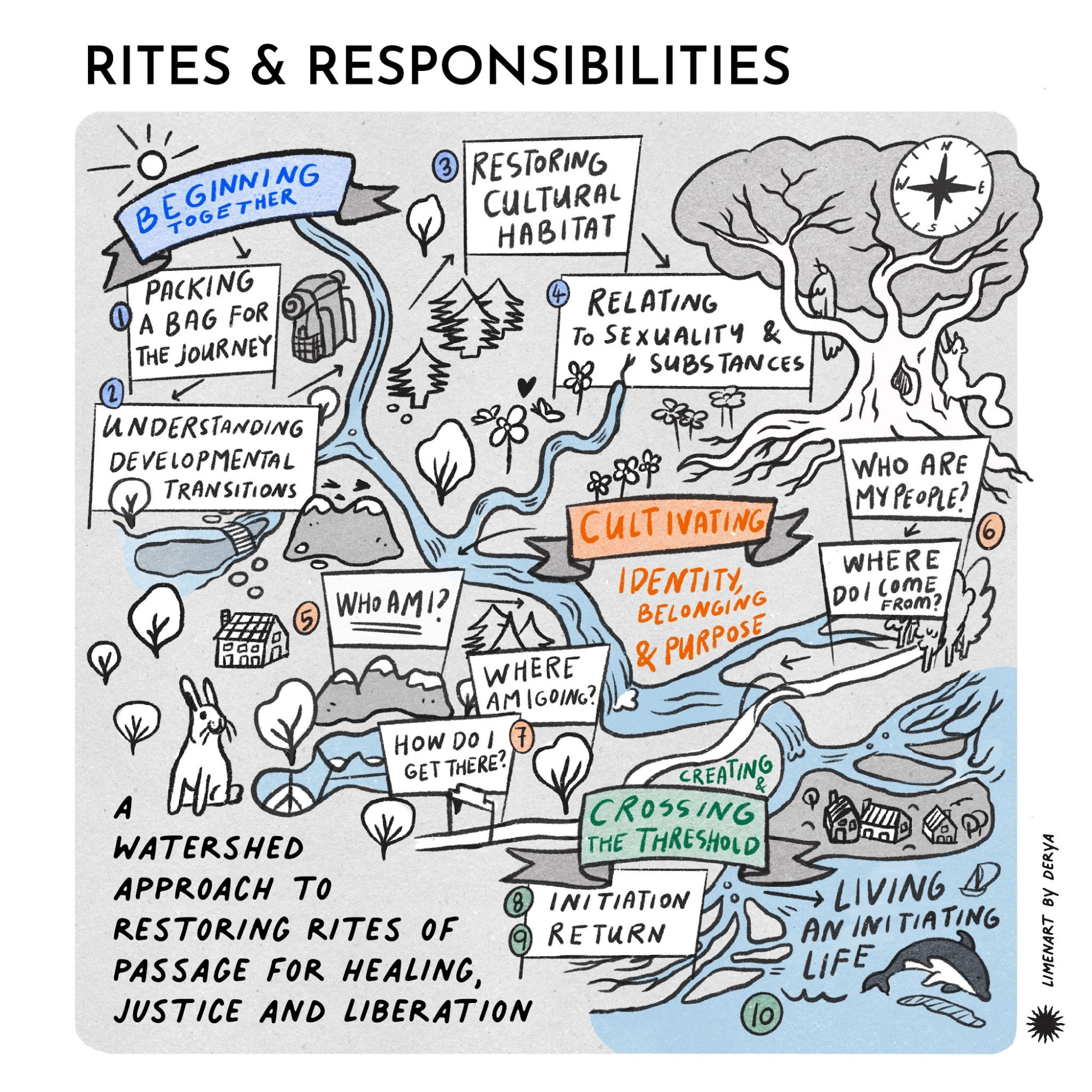
The Seven Pathways of Cultural Habitat Restoration
No matter the offering, our work orients to community-based ritual practices that speak to our larger framework of Cultural Habitat Restoration. Over the past few decades, members of our team have been facilitating and co-creating practices within these seven pathways:
-
“There may be no time more suited to the study of rites of passage than the threshold between the end of modernity and the uncertain future of humanity.” –Mythologist Michael Meade
Rites of passage are a set of diverse cultural practices designed to intentionally honor life transitions. Many of the social issues we face today, from individual isolation to the rise of white nationalist hate groups and other forms of extremism, have their roots in, or are amplified by, the loss and contortion of these practices. When such practices are lost or destroyed, everyone suffers. When they are restored, the whole community can flourish. Through processes of initiation, individuals shed what has become too small for them, and are challenged and supported in developing the inner resources and understandings to bring their unique gifts forward—into a world that urgently needs what they have to offer.
In an age of climate devastation, global war and famine, large-scale industrial extraction, rapid technological change, and the lasting legacies of past and present colonial violence, we are alive in a time of great precarity and tumult—which means we are also in a time of great possibility. If change is inevitable, we might as well do change well: letting ourselves be transformed in the process, rather than fighting it every step of the way.
Within these initiatory times, rites of passage instill a sense of belonging, teach transition literacy (the ability to read, understand, and navigate change), and call forth the unique gifts we each hold, in service to our wider communities. Everyone has a right to a vibrant, life-affirming culture imbued with meaning, a culture that views each person as an essential piece of the greater whole. And everyone has a responsibility to make their life as full, rich, and meaningful as they possibly can. Grounded in human developmental theory and the practicality of developing meaningful rites of passage for a variety of life transitions, Rites & Responsibilities offers a compass—and trustworthy guides—for that life-long journey.
-
Amidst our personal losses and the ecological and social catastrophes of our times, we need spaces to grieve together, in community. The Rites & Responsibilities team is available to support you in navigating personal loss and/or creating community spaces for grieving. Members of our team carry particular grief-tending lineages, including Dagara cultural practices as shared by Sobonfu and Malidoma Somé, and The Work That Reconnects as taught by Joanna Macy.
-
Part of Cultural Habitat Restoration involves stepping into the rhythms and cycles of the earth, sun, moon, and stars, in a particular place. When we tend to iterative cycles of action and rest, rooted in regular practices for marking, honoring, and celebrating transitions like the change of seasons and the phases of the moon, we can ground ourselves in sustainable, regenerative rhythms that stand in strong contrast to the pace of grind culture demanded by modernity. Our ancestors—wherever we come from—knew how to do this, and want us to remember their ways. Finding and restoring practices to attune ourselves to these cycles, in ways that make sense for our lives today and for the lands and waters where we make home, builds our resiliency. Doing so together, in community, creates collective coherence, opportunities to learn and grow together, and offers a legacy for future generations.
-
How we make decisions and agreements—and communicate them—for ourselves and for groups we are part of, can be tricky business. It can also be very empowering and clarifying. Many of us grew up with poor role modeling around boundaries, were taught to override the wants and needs that our bodies and emotions signal, or were taught to collude with others to do the same. Meanwhile, we see coercion and disregard happening to peoples and places all around us, in subtle or not-so-subtle ways, like the treaties between the United States and tribal nations—and all the places where those treaties have been broken, are nonexistent, or were gained by coercion and trickery.
What does it mean to give and receive with consent?
What does agency truly feel like to you?
What practices can help us make decisions or agreements as an individual, partnership, or group in ways that are efficient, effective, and empowering, while honoring the needs and boundaries of everyone involved?
These are some of the questions the members of the Rites & Responsibilities team have been living into. With practice comes transformation and healing. Some members of our team are somatic consent facilitators or holistic sexual health educators; others are versed in organizational decision-making and collaborative leadership processes. All carry an awareness of how dynamics of power and privilege can impact our sense of agency and choice, as well as a background in embodiment practices, and offer specific tools and practices to support individuals and teams in the creation of mutually supportive, trustworthy agreements.In an effort to learn more skilled consent practices in support of agency and choice, Rites and Responsibilities offers monthly Intro to the Wheel of Consent drop-ins, both in-person and online. These workshops support participants to:
Notice and honor signals from your body, including your sense of safety, your wants, and your willingness,
Trust yourself and consider what deepens trust with others,
Value yourself and others,
Communicate clearly and confidently.
To register or learn more, click here.
-
How do we navigate the hurts, harms, or transgressions that come up in our relationships? What practices do we have for metabolizing the ways we’ve been hurt, had our boundaries violated in big or small ways, crossed the boundaries of others, or were operating from a different set of understandings?
Conflict is the outward manifestation of tensions that might otherwise go unacknowledged. As such, conflict, handled skillfully, can be profoundly generative. Yet many of us learned growing up to be afraid of conflict, or to avoid it at all costs. Others grew up with conflict as the norm, and are surprised when those around us get scared or retreat in the face of it.
At Rites & Responsibilities, we see the regeneration of practices for navigating conflict, and–where appropriate–the ritualization of repair, forgiveness, and/or reconciliation, as a core component of Cultural Habitat Restoration. We hold these processes with a deep attention to the embodied experience of any conflict situation, awareness of dynamics of power, privilege, and oppression, alongside continued support for individual and collective nervous system regulation. Collectively, we hold a Transformative Justice lens, and bring this into our work supporting individuals, couples, and teams in navigating conflict. -
At Rites & Responsibilities, we believe that part of our collective healing comes from practicing ways of being with resource flow rooted in sharing. We’ve learned that how we gift, share, and exchange are a form of ceremony, and we can practice in ways that help us transform rather than reinforce feelings like fear, shame, greed, and a sense of scarcity that, for many of us, have been part of our cultural conditioning. We are actively practicing and researching what free flow of exchange and sacred reciprocity look like under the structural conditions of corporate capitalism, and are excited to share our learnings with others and be in shared practice together.
We’re here to support and accompany you, whether you’re looking for:
support around your personal finances or class background;
the financial model of your business, collective, or organization;
wish to bring forth gifting ritual practice within your community.
Part of our learning is leading us toward regenerating rituals of thanksgiving, gifting, sharing, exchange, and redistribution. There are practices within many if not most of our ancestral lineages to ensure that everyone’s needs are met and nobody has too much, and we, too, can practice ways of giving and receiving that align with our deepest dreams and desires for the world. Just as we do with conflict repair, we hold these processes with a deep attention to the embodied experience, awareness of dynamics of power, privilege, and oppression, alongside continued support for individual and collective nervous system regulation.
-
Somehow, amidst the swirl of modernity and the hyperconnectivity of our digital age, we’re living in a time of pervasive loneliness and isolation. We are in such a crisis of belonging today that, in 2023, the US Surgeon General declared loneliness a pandemic.
Yet at our core, each of us belongs, and is inextricably connected to all other beings within the web of life. In addition to rites of passage that affirm and mark a transition in our lives, from time to time, we too must mark and affirm our inherent belonging with a place, a person, or group of people whom we claim/are claimed by. We may find it’s time to make a clear commitment and be witnessed by others in this declaration.
In addition to our community offerings and direct services, we are happy to offer tailored support oriented within these seven pathways. If you are interested in working with Rites and Responsibilities to customize an offering, please reach out.

Methow Valley Offerings
If we will have the wisdom to survive,
To stand like slow-growing trees…
If we will make our seasons welcome here,
Asking not too much of earth or heaven,
then a long time after we are dead
The lives our lives prepare will live
Here....
—Wendell Berry, “Work Song Part 2: A Vision”
While distance-based learning supports cultural repair in vital ways, Cultural Habitat Restoration is ultimately place-based work, rooted in particular lands, waterways, and communities. Working in our home ecosystems, we meet the land in embodied practice, and learn what’s possible when we work together, in place, to foster emergent, relational, local potential.
At Rites & Responsibilities, we are cultivating the intentions of Cultural Habitat Restoration in the traditional homelands of the mətxʷú people, in the Methow Valley of North Central Washington. We see this as long-term, multigenerational work, done in slow relationship between individuals, communities, and organizations. Our intention is to support community systems to make it easy for any and all in the Methow Valley to access:
Spaces to mark and support change at multiple levels - personal, social, and cultural;
Multi-cultural, cross-class, intergenerational spaces for truth-telling, healing, and repair;
Accessible, interfaith ritual spaces designed to help us process and be with the complexities, stressors, and griefs of our times;
Coordinated public spaces in which seasonal cycles (in our lives and in the world) can be explored, honored, and marked.
Resources to support sufficient livelihood for community practitioners, healers, artists, culture workers, and visionaries to offer their gifts toward healing in our community and beyond.
Working in our home ecosystems, we meet the land in embodied practice, and learn what’s possible when we work together, in place, to foster emergent, relational, local potential.
-
“The Methow Community Ceremony, rooted in Rites & Responsibilities, was one of the most meaningful ceremonies of my life. It was both an affirmation of who I am and a life-changing experience. To be supported, encouraged, and challenged by such skilled practitioners and guides as Darcy and Scott, was remarkable. Through the practices of council, listening and speaking from the heart, rituals of letting go, and solo time on land. they helped me to see myself more clearly and the gifts that I can offer my community. Remembering who I am in this interconnected web of creation is a gift indeed!”
— David Lafever
“Darcy’s lessons, professional expertise and educational background have greatly benefited both myself and my students throughout our 15 years of collaboration. Darcy has facilitated over 20 interactive workshops, field trips, panels and discussions with both my Junior High and High Schools students. In her wise and thoughtful approach, Darcy challenges students to step out of their comfort zones to discuss intricate topics such as cultural appropriation, racial and ethnic diversity, pertinent social justice issues, and the difficult history of how colonization affects Native American tribes and settler communities. Darcy has not only shown me how to improve my own teaching practice, but has also modeled how to be a conscientious member of society.”
— Dani Golden
Join us for these upcoming offerings in the Methow:

9-Month Course
“Rites of Passage are a cultural antihistamine to a socially toxic culture”
– Elder Paul Hill, Founder of National Rites of Passage Institute
The Rites & Responsibilities 9-Month Course offers an online communal inquiry and initiatory journey for those committed to generating meaningful passages in their lives, families, and communities. While this has previously been offered as a white caucus space to facilitate dialogue and repair within settler lineages, we are listening for what best serves the community in this next cycle of offerings, and may offer this as a cross-cultural, multi-racial course.
Designed for educators, therapists, guides, healers, organizers, mentors, parents, youth and community leaders, and anyone ready to roll up their sleeves and co-create rites of passage for their community, this curated, online series is based on Rites and Responsibilities: A Guide to Growing Up and learned best practices in the field of rites of passage.
Over nine months, in a slow-and-steady arc, we will build a community of mutual care, support, and accountability as we bring meaningful, culturally-responsible rites of passage ever more deeply into our lives, families, and communities. As we study, share, reflect, practice, grieve, organize, and celebrate, we will create space for our points of connection and shared experience as well as honoring the intersectional differences between us. Participants will receive individualized support for the specific contexts they are working in and/or work in caucus spaces to deepen their practice.
“This course has changed my life. I no longer move from a place of urgency, instead I center my relationships with my human and more than human kin and move from a place of deep listening, embodiment, and heart centered action.”
— RR
-
Participants will:
Connect with others working to bring meaningful processes and practices for growth into their communities
Explore the resurgence of rites of passage today, and how these efforts fit in with decolonization and other global change movements
Explore human development from neurological, psychological, cultural, and ecological perspectives
Reflect on the impacts of sexuality and consciousness-shifting substances in their own initiatory journey, and the roles they play in rites of passage more broadly
Explore the role of identity development in rites of passage, including: dynamics of power, privilege, oppression, and difference; the ways these manifest in terms of race, ethnicity, religion, gender, sexual orientation, ability, class, citizenship, and more; and how this impacts our work and those we serve
Investigate the causes, consequences, and complexities of cultural appropriation, and co-create ancestrally-rooted, culturally respectful alternatives
Build capacity to design and/or lead healthy passages, for themselves or others in their community
-
This course is for you if:
You are committed to healing, justice, and healthy passages for yourself and your community
You value learning in community
You yearn for authentic, meaningful, emergent culture
You see a connection between individual and cultural healing, wellness, and transformation
You are able to show up with care, grace, and self-awareness in community
You are committed to ongoing learning and inquiry regardless of how much work and learning you have done already
This course is not for you if:
You are committed to specific outcomes and deliverables on a set timeline
You’re not interested in the connection between rites of passage and social justice
You aren’t willing to make space for others who use different language than you do
You don’t have time and space in your life to devote to the ongoing study aspects of this course
You are looking for fixed answers to the questions we are engaging

13 Moons Journey
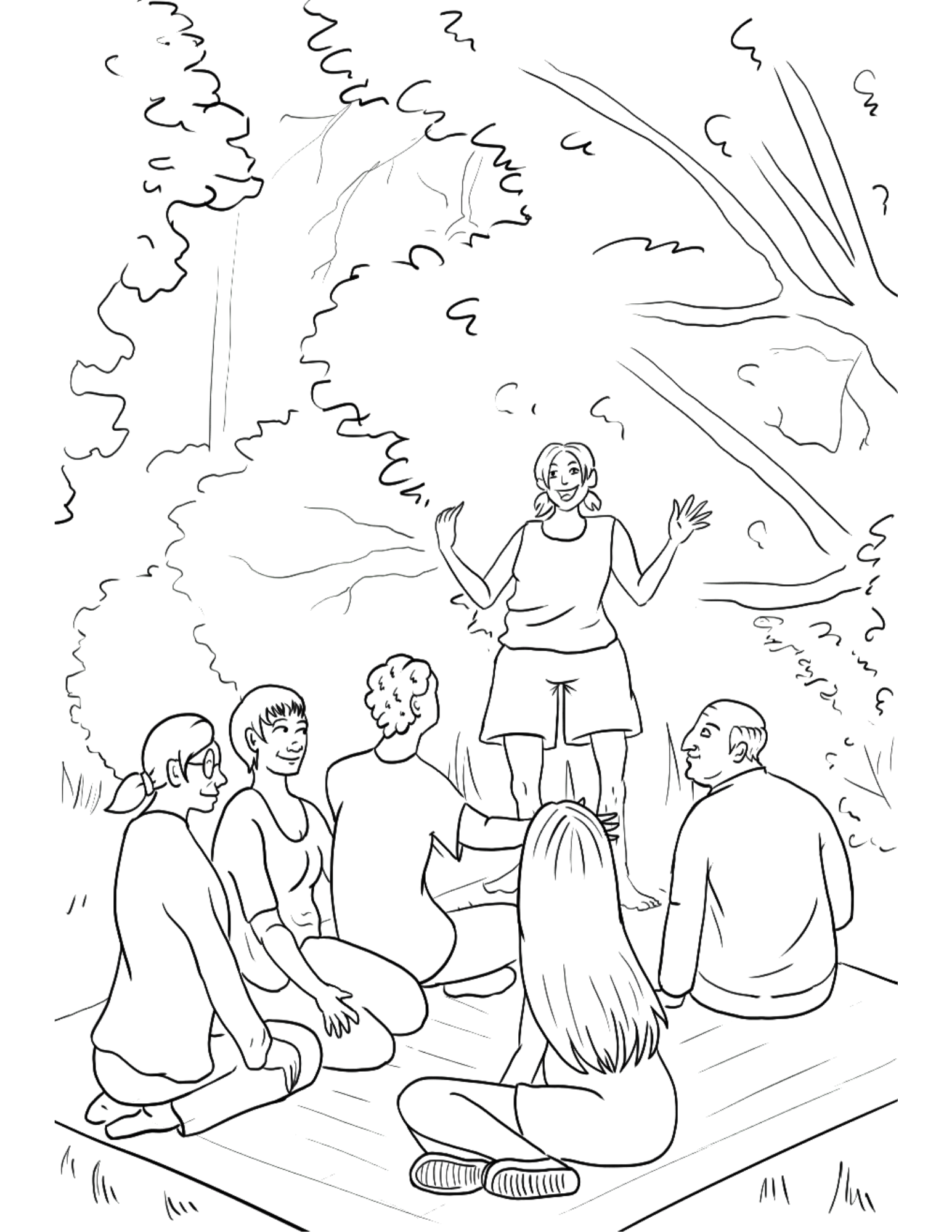
The Rites & Responsibilities 13 Moons Journey offers a year-long cycle of learning and exploration held by natural rhythms, seasonal shifts, and support from a core Rites & Responsibilities guide of your choice.
It’s a simple, organic, and emergent process: we’ll work together to identify a clear theme for the journey, articulate intentions, and customize a basic map for a one-year (13-moon) cycle of learning and exploration. This includes identifying general areas of focus. This focus may be a body of work you’ve been dreaming of bringing into the world, or could be an area of inner exploration that needs containment and support. Next, we’ll identify specific tasks and practices to be engaged according to the natural rhythms of the day, moon, and seasonal shifts. This might be specific earth intimacy practices, for example, or creative projects that will be part of the arc of your time.
Once we’ve set out a map together, you’ll be invited to give yourself over to the process, tracking what emerges as it relates to the intentions you’ve called forth. We’ve experienced powerful learning, growth, and transformation by the end of the year’s cycle.
There are two structures for this 13 Moons Journey:
-
The 13 Moons Accompaniment offers this year-long journey on a sliding scale basis:
For $1600-3000, you receive one coaching session per moon.
For $2600-5075, you receive two coaching sessions per moon.
Both bundles include two preparation calls, one integration call, text/email support for the duration of the 13 moons cycle, and the shared materials to support your 13 Moons Design Process.
As with all of our work, if cost or payment schedule is inaccessible, please reach out with a proposal for what would feel accessible, and let’s work together to see what’s possible.
-
The 13 Moons Apprenticeship offers a work-trade option for the journey: apprentices serve as a research and/or communications support in exchange for support and guidance during the year-long process. Typically, this trade is on a 5-to-1 hour basis, meaning that Apprentices devote 5-10 hours per month to supporting Rites & Responsibilities research and communications in exchange for 1-2 sessions a month throughout the 13 moons. Generally, apprentices are provided with 3-4 projects they might contribute to depending on skills and interest areas, and select 1-2 that most resonate with them.
-
After years of searching for the kind of soul-based healing that she needed in the wake of childhood sexual abuse, Marisa Withey Byrne came to a conclusion: she was going to need to create her own pathway for healing, with the tools she'd gained through ceremony and rites of passage. 13 Moons was born, as Marisa created a process for her own learning and healing, and transformed her suffering into a curriculum for holistic sexual health.
Watching Marisa's process, Darcy was inspired. As she too set about articulating and developing her own body of work—Cultural Habitat Restoration—she went on her own very different 13 Moons journey, which she called an "embodied exploration of boundaries and flow."
Along their journeys, both women watched as others became curious about their process, and wanted to embark upon their own 13 Moons journey. The two women began offering their story and framework for others, and immediately saw how the principles and processes could translate as a simple template for healing, learning, and self-initiation that could serve others on their own creative edge, without a clear guide to follow, as they bring together bodies of work, find paths for healing, and offer their gifts to others.

Additional Ways to Work with Us
Do you want to bring these tools and practices into your life, community, or organization? Beyond our established offerings, the Rites & Responsibilities team is available to support you or your team through one-on-one coaching, organizational/group consulting and design, and customized training or facilitation.
Whether you’re seeking support as you navigate your own questions and transitions, are looking for help in creating an experience for your family or group, or want to host a training or experience in your community, the Rites & Responsibilities team can help you in ways that are grounded, accessible, and culturally responsible.
If you are interested in working with Rites & Responsibilities for tailored individual, organizational, or community support, please reach out.
Rites & Responsibilities is available for tailored support in any of the seven pathways of Cultural Habitat Restoration.